
The Art of Translation Is Not Needing To
Why shared language is a business risk, not a nitpick
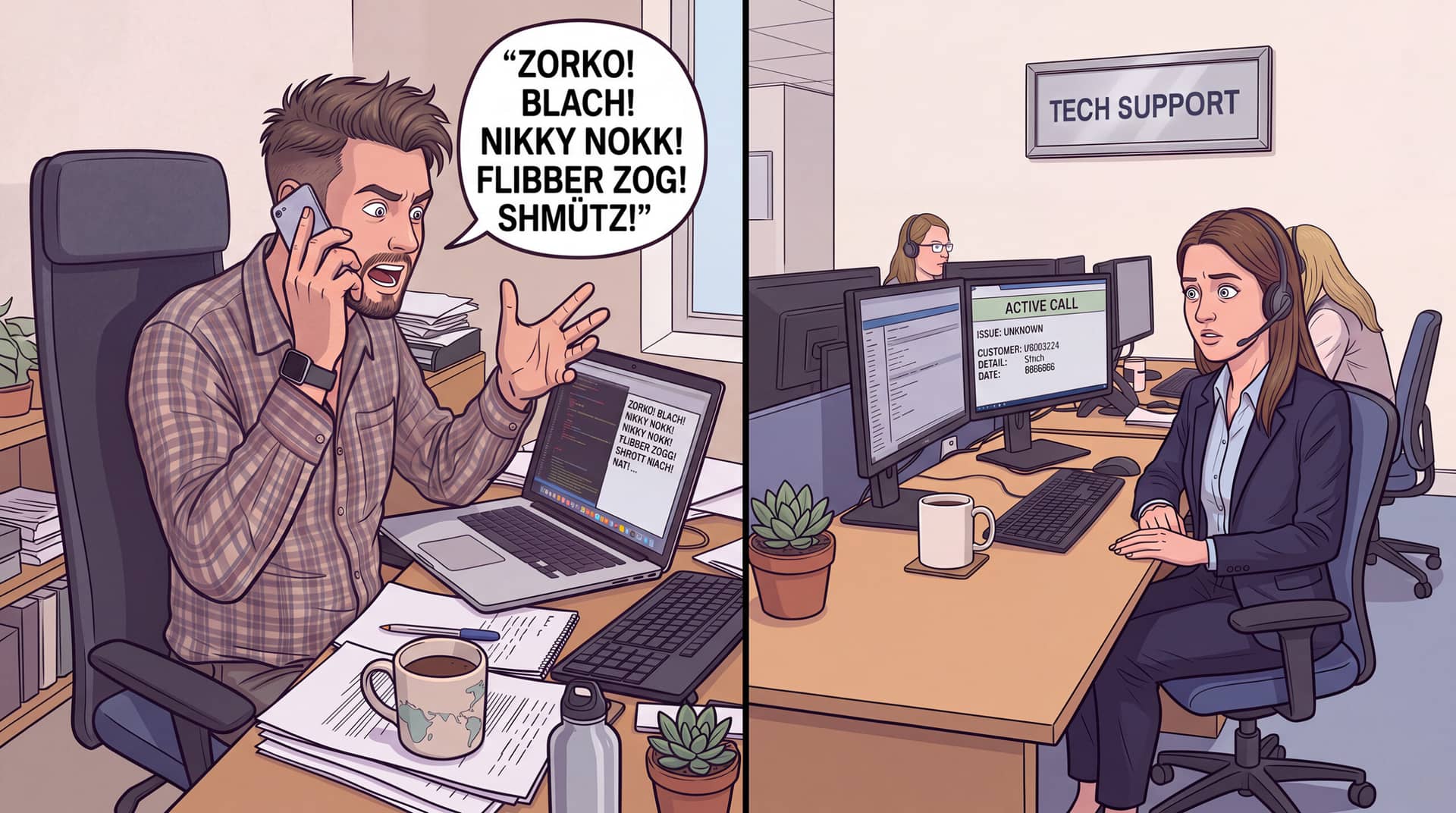
“Hey, BT-15.2 is down, they’re opening a second one, but nothing works. Fix was applied, but more lights came on.”
If you’re lost, that’s reasonable, but if it rings familiar, you may already know the pain. If, however, that looks like something you might write in a message or support ticket…stick around, you may find something useful below.
Go ahead, read it again. The grammar is fine. The spelling is fine. The punctuation is likely better than most chat messages we see in a day. So why can’t you make any sense of it?
Because it means nothing, on purpose, it is gibberish, but it serves the point. It’s like a zoomed-in snippet of thought from someone so deep in an issue they’ve forgotten how it might sound to anyone else.
It’s stressful to the audience, alienates the messenger, and doesn’t make progress
Why do you care?
After years in software development and business analysis: miscommunication is one of the most expensive things on a project, and it’s never tracked. It never shows up as a line item. It shows up as duplicated work, reinventing the wheel, redoing what was already done because someone didn’t get (or didn’t understand) what was said. Without context, your reader is left wasting time on translation. When an issue is presented live, a brain busy translating and filling in the gaps is a brain missing details. Time is money, and cliché aside, the bill lands in two places:
- Your client feels it. They may never spot it on an invoice, but they feel it in questions like “Why is this taking so long?” and “I thought we already went over this.” Every one of those chips away at credibility and confidence in your team.
- Your company feels it. When you and your colleagues are tied up redoing work, you’re unavailable for the next project. That’s lost potential in earnings and relationships.
No single moment convinced me of this. It was a collection of experiences that all pointed at the same core: client feedback, reports with no context, duplicated work with no clear source of truth – all lead to waste, mistakes, and, maybe worse of all, compromised image.
So why doesn’t everyone just speak up when they’re confused? One of those hurdles: ego. Often people who most need to ask questions (new hires, the quiet ones, anyone worried about impressions) are the least likely to. They feel a bit like Andy from Parks and Rec: “I don’t know what that is, and at this point I’m too afraid to ask.” Painfully apt. Which means “just ask more questions” isn’t the only fix, and that’s where the emphasis shifts to a two-way street.
Where I’ve seen it up close
I’ve come at this problem from a few different seats.
Tech Helpdesk. I handled phone and in-person support, and it taught me that people describe problems through the lens they know, or through the impact they feel. The classic is “The website is down.” That’s all they experience, so that’s all they report. A trained tech follows up with discovery questions, the very ones you’d be annoyed to be asked yourself. (“Have you tried rebooting it?” We’ve all been on the receiving end.) I also worked with a real, living, breathing Vogon, if you’ve read The Hitchhiker’s Guide to the Galaxy: a co-worker who strictly adhered to process. Even when he knew the answer, everything went through a ticket. At the time, I couldn’t justify the cost to efficiency. Now I understand it: a little cost today buys a lot of efficiency tomorrow.
Software Engineering. Before my current role as a business analyst, I was a software engineer. In code it’s good practice to give variables, methods, and classes meaningful names. Note that I said “good practice,” not “strictly enforced.” I once inherited a project to revamp, whose variables were named “a, b, c”. Even the original author would have struggled to trace that logic if they had to revisit it after a few months. Hours disappeared while following references before I could produce a single thing of value.
Business analysis. On one engagement, the same information lived in multiple copies of a document, none of them with any context about which was current. Each had been “good enough” when written. The fix wasn’t glamorous: verify the information, pick one document as the source of truth, update every reference to point to it, and retire the stale copies. Unfortunately, it’s hard to pull metrics on problems that never happened, but having seen and experienced the waste firsthand, I knew correcting it was the best course of action.
Three seats, one pattern: something made perfect sense to the person who said or wrote it, in the moment, and to nobody else afterward. Over the years, I’ve noticed that miscommunication tends to fall into a few categories. Naming them makes them easier to spot in other people’s messages and, more importantly, in your own.
Three ways understanding slips
1. The Slip: Stated Incorrectly
Picture a data-migration kickoff. Someone says, “We’ll map Created Date straight across,” and heads nod. But in the source system, Created Date is when the file landed in the system. The business means when the original was actually produced, which lives in a different field with a similar name. One word, no ill intent, and nobody in the room notices.
That’s a Slip: a simple error. We all multitask, even when we don’t mean to, so it’s no surprise when one thought blurs into another, especially when things sound alike, look alike, or live in the same concept neighborhood. Nobody’s at fault, but catching it faces two hurdles. First, someone must know the correct information, which is rarely the case when the audience is hearing the topic for the first time. Second, someone must be willing to say so, and correcting a person, especially in a public forum, is widely regarded as impolite.
The impact: Left alone, a whole library of records migrates with the wrong dates. Nobody notices until search or reporting misbehaves, and then comes the remapping, revalidating, and re-explaining. Duplicated work, again.
What I’ve learned: In the moment, three things matter: know what you’re talking about, have the confidence to speak up, and deliver the correction tastefully. A question lands softer than a verdict: “Quick check, which Created Date are we talking about, capture or upload?” Outside the meeting, it’s the same discipline. I’ve done several mapping exercises, lining up three or more databases, where the documentation was “good enough” when written, and described a system that no longer existed by the time it reached me. Every small discrepancy raised the same question: Is this worth bothering someone about? The answer is always yes. Otherwise, it will be egg on your face for green-lighting the misalignment. When I’m in the audience, I take notes, test the system myself, and bring my questions at the right moment. When I’m presenting, I prefer a show-and-tell approach, letting people try it themselves, addressing issues and questions as they come up.
2. The Missing Link: Not All Information Gets Everywhere It Should
Picture a DAM rollout. In a requirements workshop, the group agrees that the “Usage Rights” field is mandatory before anything gets published, and that “Approved” means legal has signed off, not just that the creative lead likes it. Marketing ops and creative are in the room. The regional teams and the agency that uploads most of the assets are not, and the notes live in one person’s inbox. A few weeks later, regional uploaders mark “Approved” on everything they consider finished, and search fills up with assets nobody cleared. Then a client executive finds one during a demo, and now it’s an escalation.
Nobody did anything wrong. The process was explained to some people, but not all of them. That’s the Missing Link: an email, a meeting room, or a call only reaches so far. Silos are common, and they can protect people from overload, but the flip side is that the subject matter expert should get what’s needed to where it’s needed. That takes emotional intelligence: patience with questions that aren’t pertinent, and the humility to accept that they might have made a mistake. Yet an SME is only one actor. Everyone on a project shares the responsibility to inform and educate when something new comes up.
The impact: duplicated effort and something harder to repair. When knowledge isn’t easily accessible, the disconnect reaches the client, confidence takes a hit, and they start wondering whether there’s truly a team behind their investment.
What I’ve learned: This one has gotten much easier. Meeting recordings and AI note-takers make it simple to pass along the pertinent information, so nothing depends on one person’s memory. Pair that with a central repository for files, messages, meetings, and contact info, and everyone who needs to be included can be. A good test: if someone joined tomorrow, could they find out what was decided, and why?
3. The Lens: Assumed Understanding Shaped by the Outcome We Want
A few years back, I worked with a client who had mastered creating their own reality. They’d describe the desired future state as if it were already coming to fruition, re-presenting information we’d given them with their own scope layered on top, or swapping out facts to fit the picture they wanted. The tricky part: this took place offline, as a byproduct of their scope, and only surfaced once it had solidified and been presented in a meeting. We course-corrected several times, but the practice never stopped.
At go-live, they had some very interesting expectations for the end product, despite having been part of the process the entire way.
That’s the Lens. None of us operates in a vacuum. We have outside pressures and internal goals, and we take in information through a lens made of past experience, cultural habits, and the pull toward a particular result. It usually works subconsciously, showing up as a hunch, a tug, or outright resistance to what’s being communicated. To be clear, none of this assumes bad intent. Bad faith may exist in the world, but how to handle that deserves its own article. This is just human nature in action.
The impact: It can show up in a few ways. In the best case, they accept their misunderstanding. Sometimes it turns into an ask to make their understanding a reality. In the worst case, they stand firm on what they heard and even blame you when that reality doesn’t materialize.
What I’ve learned: In the meeting, course-correct tactfully and respectfully. Afterward, recaps and follow-ups clarify everyone’s tasks and deliverables for the next meeting or deadline. Due diligence is your best friend. The impossible scenarios are outliers, and there’s no preparing for those, nor would it be worth the effort. Spend that energy on the best case instead: look for the compromise (winning but giving back speaks volumes) and treat the misunderstanding as an opportunity to set yourself apart.
Good communication starts with identifying the problem
All of this comes together when someone hands you a problem, especially a customer. Good communication here isn’t about eloquence. It’s about giving the other person enough to start. Back to “The website is down.” That’s a symptom, from where the customer stands. Depending on how niche or deep the issue is, these are the three things I most want to know:
1. What exactly is broken? Describe what you see, not just the conclusion you’ve drawn from it.
2. How does it behave differently than before, and what was happening when it broke?
3. What have you already done or tried to fix it?
A few small things make a big difference: a date and timestamp, screenshots, hyperlinks, and no assumptions. Tell us the origin, too: what are you trying to accomplish overall? And cover the basics so there’s no easy win left on the table (yes, sometimes it really is the reboot). Detail doesn’t mean a novel, though. Lead with the three items above, or your audience’s attention will TLDR right out.
If you’re the customer, give as much detail about the issue as you can, and let your support person guide the breadth and depth from there. These discovery questions aren’t a quiz. They’re how we narrow it down together. Try rewriting BT-15.2 with the three items above, and you’ll have a ticket better positioned to be acted on.
Failure is growth
Everyone makes communication mistakes. The Slip, the Missing Link, and the Lens happen to the best of us, and each one is a growth opportunity if we take the time to reflect and build practices that help us and the people around us avoid the pitfall.
What helped me most was patience, with myself and with others. It improved my communication, and it earned me more leniency than I would have been granted if I had been “perfect” from the start. Do yourself a favor: document like you have no idea what’s going on, because in six months you may find yourself in Gandalf’s shoes, “I have no memory of this place” (LotR), and you’ll feel like a wizard for having had the foresight. It also makes handing off processes much easier.
The heart of the fix is discipline: self-imposed, methodical, strict, and highly adopted. Though “be disciplined” is a great sentiment, it doesn’t make much for a blueprint or steps to follow. Deciding what deserves to be captured, who owns it, how it stays alive as people, products, and vendors change, and how it fits the way your teams actually work takes more than good intentions. It looks different at every organization, and getting it right is where the real payoff is.
Thanks to AI tools popping up, we may get better at surfacing the right definition at the right moment. But a tool can only surface what someone has the discipline to document in the first place.
Getting everyone, inside and between organizations, onto the same page is a big part of the challenge I enjoy tackling. What’s the best (or worst) jargon mix-up you’ve run into?